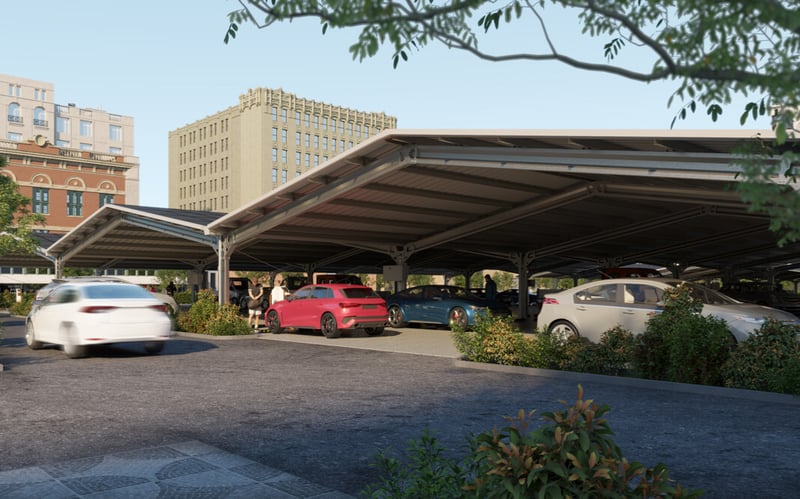


Councils are at the top of the list when it comes to unrealised potential to generate renewable energy
Their assets stretch from thousands of public and office car parks, park and rides as well as leisure and community centres with much of the land remaining ‘dead space’.
At the same time, energy bills for councils in England and Wales are one of their biggest costs at around £680 million a year, rising by a massive 74 per cent collectively for 2023.
Solspan examines the top five areas councils could transform into green energy to slash council bills and reduce their carbon footprint, help power the nation and provide cheap EV charging to the public and staff.
Park and ride car parks
There are around 130 park and ride car parks around the UK made up of around 70,000 car parking spaces, many located next to historic cities like Oxford to ease congestion and pollution.
If all these car parking spaces were covered in solar carports it would produce around 140,000 kWh a day, which has the potential to provide power to around 18,000 homes a day depending on daily consumption.
In addition, solar carports can provide EV charging, another excellent opportunity for councils to make money and for drivers to charge their cars while they’re visiting a town or city.
Public car parks
According to a report by the British Parking Association, council-run car parks operate at between 50 to 80 per cent occupancy rate.
There isn’t a conclusive figure for how many car parks are owned and run by councils and local authorities, who also own staff-only car parks.
However, the same BPA report estimated there were around 17,000 car parks in the UK with around half of these owned by councils and local authorities.
It’s difficult to know the exact number of car parking spaces these equate to but the RAC Foundation estimates it would be around three to four million, which conservatively equals around 1.5 million council run car parking spaces.
If even half of these were covered by solar carports, they could potentially generate enough energy for council offices and facilities such as libraries and community centres or for 1.5 millon homes a day as well as all the potential EV charging.
Leisure centres
There is an estimated 2,727 council-owned leisure centres, including swimming pools, tennis courts, golf courses, gyms and sports halls across the UK.
And like all sectors, energy costs for leisure centres have risen dramatically, with some facing increases of 100 per cent or more.
Reports have highlighted the impact of energy price hikes on leisure centres, estimating bills have risen from £500 million in 2019 to between £1 to £1.2 billion.
For example, according to the Local Government Chronicle individual centres such as those operated by Freedom Leisure, saw their annual bills increase from £8 million to £20 million.
Saving Money & Efficiency
One way leisure centres could stop paying so much in energy bills is to become their own energy supplier by covering their car parks with solar carports.
In addition, they could increase their energy production by providing additional sports such as padel courts, provide all year round sports facilities by covering courts in canopies, or adding other services such as a dedicated café in a canopy to bring in more cash.
By providing EV charging stations with solar carports or canopies, leisure centres would increase dwell time and revenue by charging customers to recharge their cars while they used the facilities.
Unused land and playing fields
Research shows councils in England and Wales own nearly 320,000 small sites of unused land of three acres or less, adding up to nearly 100,000 acres.
It is unclear if there are existing buildings on the sites but if they are lying fallow then councils could repurpose sites for renewable projects like solar farms or wind turbines, depending on their location.
Some councils are already using their land for renewable energy such as West Suffolk which has developed its own solar farms while others like Cambridgeshire lease land to solar farm companies.
Roof-top solar
It’s not known exactly how many buildings councils own in the UK but it’s fair to say the number is substantial.
Every village and every town has community centres, schools, administrative offices and libraries which all have the potential to generate green energy via solar roof panels.
Like solar carports and canopies, rooftop solar community projects are an ideal solution for councils struggling with ever decreasing budgets and help cut their energy bills while slashing their carbon footprint.
Our Solar Savings Calculator
Solspan has produced an easy-to-use online Solar Savings Calculator to help you work out how much energy you could produce with solar carports.
It will give you an instant ROI figure, cost and carbon savings and potential EV vehicle capacity.
If you’d like to find out more about solar carports and solar canopies, including timber, aluminium or steel carports, please contact us.
